


(312) 298-9766
Start your process.avif)
Under U.S. immigration law, the parents of a U.S. citizen are eligible to seek permanent resident status. To obtain a parent green card and start down the path to citizenship, however, your parents must apply for an IR-5 visa. Here’s how it works.

The IR-5 visa category, also known as a parent green card, permits the parents of U.S. citizens who are 21 or older to gain permanent residence in the U.S.
There’s no annual cap on the IR-5 visa category, meaning qualified applicants don’t have to wait for a visa number to become available. Once an IR-5 visa is issued and the parent enters the country, they become a lawful permanent resident immediately.
At SimVisa, our Chicago family immigration lawyers help U.S. citizens get through the IR-5 immigration process by gathering all required documentation, preparing for the final in-person interview, and avoiding common mistakes that lead to delays or denials.
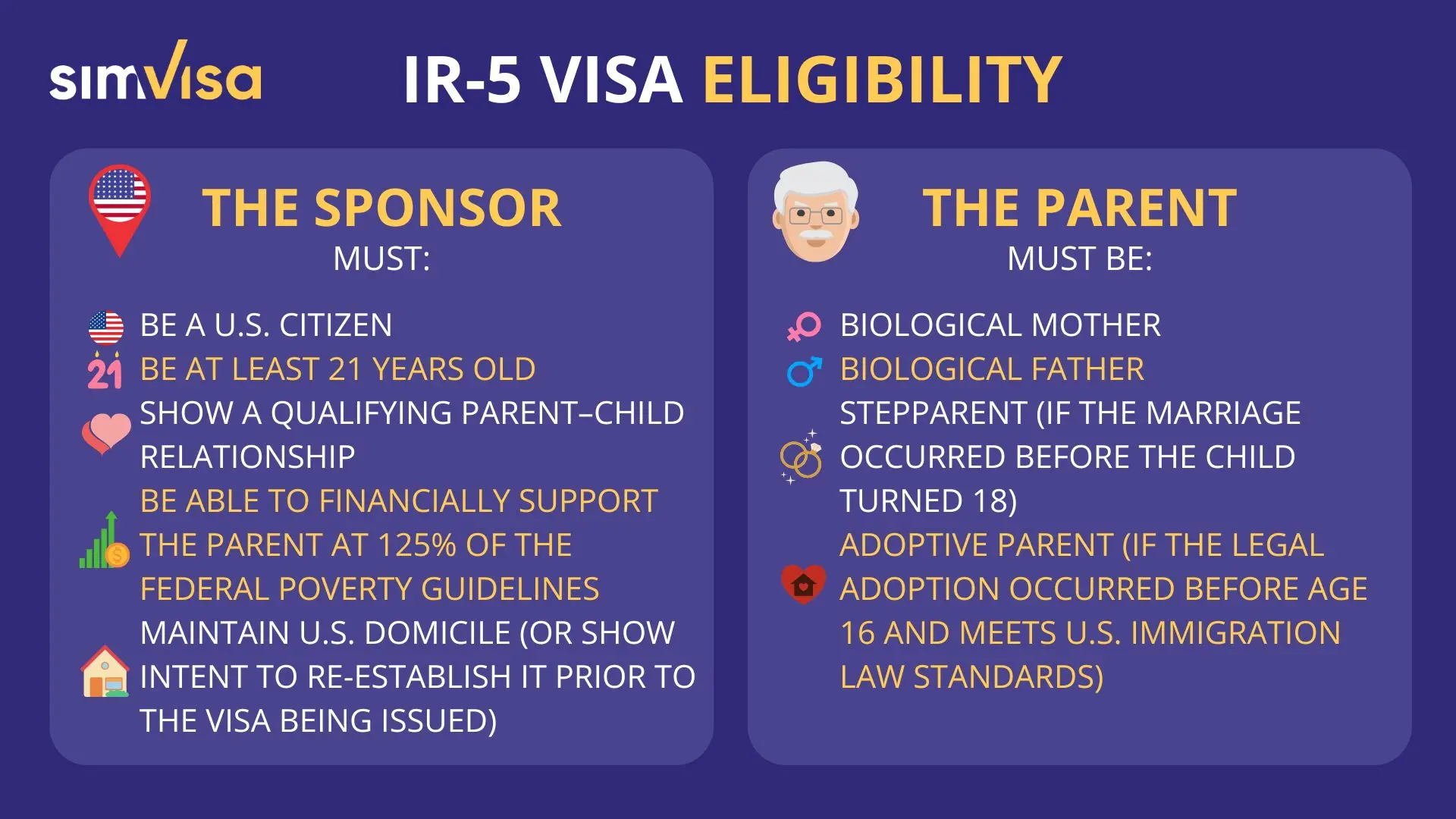
To sponsor a parent for an IR-5 visa, the U.S. citizen sponsor must meet the following core eligibility criteria:
Unlike other family preference visas, IR-5 visas are in the immediate relative category, meaning there’s no waiting list and no priority dates to track.
A parent may qualify if they bear any of the following relations to a U.S. citizen:
It’s important to note that IR-5 visas apply to parents of U.S. citizens only — lawful permanent residents (green card holders) can’t sponsor their parents until they become U.S. citizens through naturalization.

Our capable immigration lawyers can guide you through the visa application process to reunite you with your parents. We understand how important the parent-child relationship is to you and will work hard to bring your family together in the United States.
Contact UsUSCIS and the U.S. consulate ask for documentation that proves the qualifying family relationship. Depending on the situation, the required civil documents may include the following:
These documents must often be accompanied by translations and must follow Department of State reciprocity guidelines.

The standard visa application process involves two primary stages:
The U.S. citizen sponsor must file Form I-130, Petition for Alien Relative, with U.S. Citizenship and Immigration Services (USCIS) to establish the qualifying relationship. Required documentation typically includes:
After approving the form, USCIS will forward the case to the National Visa Center (NVC) for consular processing. The NVC will generate a case number and send instructions to the applicant to prepare them for their next steps.
Because parents applying for IR-5 visas typically live in their home country, they’ll complete the remaining steps through a U.S. consulate:
If approved, the parent will receive a visa packet and be free to enter the U.S. Upon entry, they’ll become a lawful permanent resident and be sent their green card by mail. No separate work permit is required; IR-5 recipients may live and work freely in the U.S. without employment authorization.

Family-based immigration cases can be divided into two broad categories:
Immediate relative visas are intended for spouses, minor children, and parents of U.S. citizens. They’re not subject to annual caps, and applicants don’t have to wait for priority dates. This category includes IR-5 parent visas.
Family preference visas are for other qualifying family members, such as:
The federal government issues a limited number of these visas each year, resulting in variable wait times. IR-5 is therefore the fastest family visa pathway due to the absence of annual limits.
If a qualifying parent is already inside the U.S. on a valid non-immigrant visa (such as a visitor visa), they may be eligible to have their status adjusted instead of completing consular processing abroad. Eligibility depends on maintaining lawful entry and being admissible under U.S. immigration law.
An experienced immigration attorney can help you determine whether adjustment of status or consular processing is the better route based on your or your parent’s current immigration status, travel history, and admissibility issues.
Visa processing times can vary dramatically, but IR-5 cases generally involve the following timelines:
USCIS processing times can range from around six months to a year or longer. They vary by service center workload and staffing levels, and security checks can also contribute to the wait.
Preparing for and completing the entry interview may take a few months, depending on consulate backlogs and the readiness of the required documentation. Because interview availability differs by location, a parent in Canada may be approved faster than one in India, Mexico, or the Philippines.
Since immediate relatives aren’t subject to annual limits, the total processing time is primarily impacted by how quickly the applicant submits all of the required documents and schedules their consular interview.

Once admitted to the U.S., IR-5 visa holders:
Many Chicago families take advantage of the IR-5 visa pathway to reunite parents and adult children for medical, social, and caregiving reasons.
While obtaining an IR-5 visa may look straightforward on paper, mistakes in the application process can lead to:
Our Chicago immigration lawyers help clients:
Working with a qualified immigration attorney can be especially beneficial if:
Ultimately, entrusting your case to an attorney can make the immigration process smoother, faster, and less stressful for everyone involved.
%20(1).webp)
At SimVisa, our mission is to reunite family members across national boundaries. We’re ready to discuss the unique circumstances of your case and do everything in our power to help your parent(s) secure an IR-5 visa. Reach out today to get started.
Contact Us
Education

Our dedicated team has over 18 years of experience handling family visa applications of all kinds. We're well-versed in immigration law, and we're determined to make the process as easy as possible for you so you can be with your loved ones without any obstacles or pushback from USCIS.
When you turn to SimVisa, you’ll get:
We want your family to be together, and we’ll work tirelessly to make that happen.



We have a high success rate in approvals

We treat you with compassion, dignity & respect

We create tailored solutions for your business & family

Read the reviews below to see what our clients have to say.
Our clients understandably have a lot of questions. Here are the answers to some of the ones we get most frequently:
Yes. Parents who obtain an IR-5 visa have the same option to apply for U.S. citizenship as all other green card holders by filing Form N-600, Application for Certificate of Citizenship.
No. Only U.S. citizens who are 21 or older can sponsor a parent for an IR-5 visa. Green card holders can’t sponsor their parents until they naturalize and become U.S. citizens.
Possibly. If your parent entered the country legally and is otherwise eligible, they may be able to apply for adjustment of status rather than completing consular processing abroad. Whether this is allowed depends on their current immigration status, entry history, and admissibility.
USCIS accepts different forms of evidence depending on the situation, including:
Additional civil documents may also be required depending on the country of origin.
Yes. All immigrant visa applicants must undergo a medical examination with a panel physician authorized by the U.S. embassy or consulate before their interview. Exams from private doctors are not accepted.
No. Once admitted into the U.S. as an IR-5 visa holder, a parent becomes a lawful permanent resident immediately and may work for any employer without needing an Employment Authorization Document or other work authorization.
IR-5 parents may apply for naturalization after five years of maintaining their permanent resident status, assuming they meet all other requirements for citizenship.
No. The IR-5 visa isn’t a derivative visa — it’s issued only to the parent. Other family members, including spouses and unmarried children, must be sponsored separately under appropriate family-based visas.
The U.S. citizen sponsor must maintain U.S. domicile (i.e., a primary residence in the United States) when submitting the Affidavit of Support. Those living abroad must show intent to re-establish domicile before the parent immigrates.
No. IR-5 is an immigrant visa that leads to a green card and permanent residency. Temporary visas, such as visitor and student visas, are non-immigrant visas and don’t grant permanent residency status.
.jpg)
SimVisa's immigration attorneys for parent green card have the knowledge and experience to handle an IR5 visa. Contact us to schedule your live meeting and learn how SimVisa can help you and your family.