
You filed Form I-485 after your employer's I-140 petition was approved, and now you've received a notice: USCIS wants to see you in person. For years, most employment-based applicants skipped this step entirely through an interview waiver. That's no longer a safe assumption.
In 2026, USCIS significantly narrowed the circumstances under which it waives adjustment of status interviews, and a new discretionary policy has added another layer applicants need to understand. This guide walks through who must attend, what officers ask in an employment-based case, the documents you should bring, and the most common reasons cases result in a Request for Evidence (RFE) after the interview.
Our employment-based immigration lawyers at SimVisa prepare clients for I-485 interviews across the country, and we've built this guide around the current rules governing employment-based adjustment of status.
What USCIS Officers Ask in an Employment-Based Interview

Employment-based interviews tend to run shorter than marriage-based interviews, often 15 to 45 minutes for straightforward cases, though complex histories can extend that. Expect the officer to place you under oath and then move through several categories of questions.
Identity and Biographic Verification
The officer confirms your name, date of birth, addresses, and immigration history against your file, and checks your passport and other identity documents.
Immigration History and Admissibility
You'll be asked about your entries and exits, any prior visas or status changes, and the yes/no admissibility questions on Form I-485 itself, covering issues such as criminal history, immigration violations, and affiliations with certain organizations. If any of your answers have changed since you filed, this is the moment to correct them.
Employment-Specific Questions
Because employment-based green cards are tied to a specific job offer, expect questions such as:
- Are you still working for the petitioning employer, in the same or a similar role?
- Do you still intend to work in the position you were offered once your green card is approved?
- If you changed employers after your I-485 had been pending for 180 days or more, did you file Form I-485 Supplement J to document that your new job qualifies under AC21 portability?
If your underlying employer went out of business, changed ownership, or if your role changed materially, be ready to explain how you meet the portability requirements under INA 204(j).
Enhanced Vetting Questions
Officers are asking more questions than in past years about international travel history, foreign government contacts or military service, and social media activity. Answer honestly and concisely, and don't guess if you don't remember specific dates or details.
Documents to Bring to Your Interview
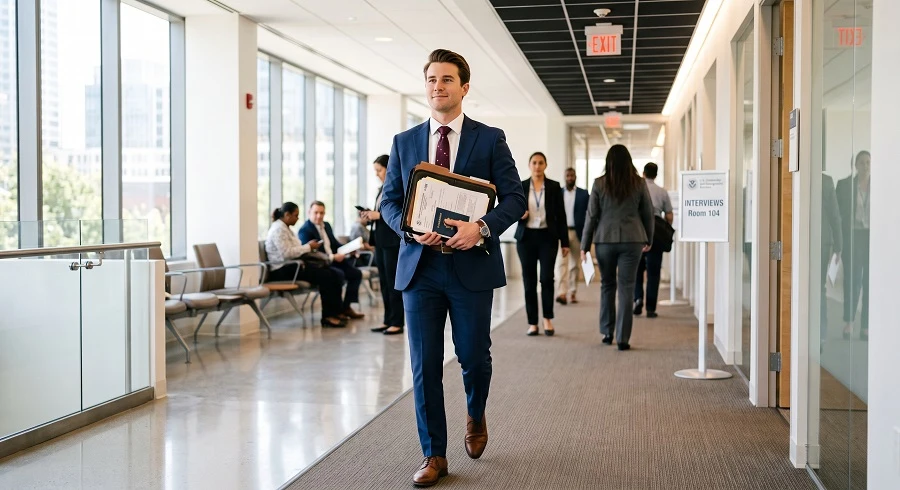
Bring both originals and copies of the following:
- A complete copy of your I-485 package, including Form I-140, I-485, I-765, and I-131, if filed;
- Your passport and any other travel documents, including your advance parole document if you have one;
- Form I-693 medical exam results (required to be filed with your I-485 as of December 2, 2024, but bring proof if there are questions about validity);
- Current employment verification: an employer letter confirming your job title, duties, and salary, plus recent pay stubs;
- Form I-485 Supplement J, if applicable, along with evidence supporting your AC21 portability claim;
- Your I-140 approval notice;
- Any updated civil documents, such as a marriage certificate or a child's birth certificate, if your family situation has changed since filing.
Organize everything into labeled folders so you can respond quickly if the officer asks for something specific.
What Happens After the Interview
An employment-based I-485 interview typically ends in one of several ways:
- On-the-spot approval. Some straightforward cases are approved the same day, and the officer may tell you verbally that your case will be approved.
- Continued review. The officer may need more time, particularly if background checks haven't cleared, and will not issue a decision that day.
- Request for Evidence (RFE). If the officer needs additional documentation, you'll typically have 87 days from the date of the notice to respond.
- Notice of Intent to Deny (NOID). A more serious step than an RFE, generally giving you 30 days to respond before a denial is finalized.
- Denial. This can happen if the officer identifies an inadmissibility issue or a discretionary concern that isn't resolved by additional evidence.
Is an Interview Actually Required for Employment-Based Cases
Under 8 CFR 245.6, every adjustment of status applicant is subject to an interview unless USCIS decides, case by case, that one isn't necessary. There's no application form or checkbox to formally request a waiver. USCIS alone decides.
For years, the agency waived interviews for the vast majority of well-documented employment-based cases, particularly in categories such as EB-1 and EB-2, where fraud indicators were historically low. That changed starting in early 2026. USCIS updated its Policy Manual to restrict the circumstances under which an interview can be skipped, citing fraud detection and national security vetting as the rationale.
Employment-based filers still fare better than marriage-based applicants (whose waiver rate has fallen dramatically), but a meaningful share of EB-1, EB-2, and EB-3 cases that once would have been waived are now being scheduled for an in-person interview, especially cases that were filed concurrently (I-140 and I-485 submitted together) or that involve a complicated immigration history.
On top of the interview-waiver shift, USCIS issued Policy Memorandum PM-602-0199 in May 2026, characterizing adjustment of status itself as a discretionary "extraordinary relief" rather than a routine benefit. The memo directs officers to weigh the totality of the circumstances, including immigration violations, compliance with visa terms, and other equities, before approving an AOS application. In practice, this means officers may probe more deeply into an applicant's history at the interview than they would have a year ago, even in employment-based cases that look clean on paper.
Who Must Attend the Interview
- The principal applicant (the employee/beneficiary) must always attend.
- A spouse or unmarried children under 21 filing as derivatives on their own I-485 applications generally must also appear, even if they aren't the focus of the underlying employment petition.
- The sponsoring employer generally does not need to appear in person. The officer's job at this stage is to confirm the applicant's identity, admissibility, and continued eligibility, not to re-interview the employer. That said, if there are unresolved questions about the job offer or the company's ability to employ you, the officer may follow up separately with the employer or request additional evidence.
If you receive an interview notice (Form I-797), attendance is mandatory. Missing the interview without advance notice and a valid reason can result in your case being denied or administratively closed.
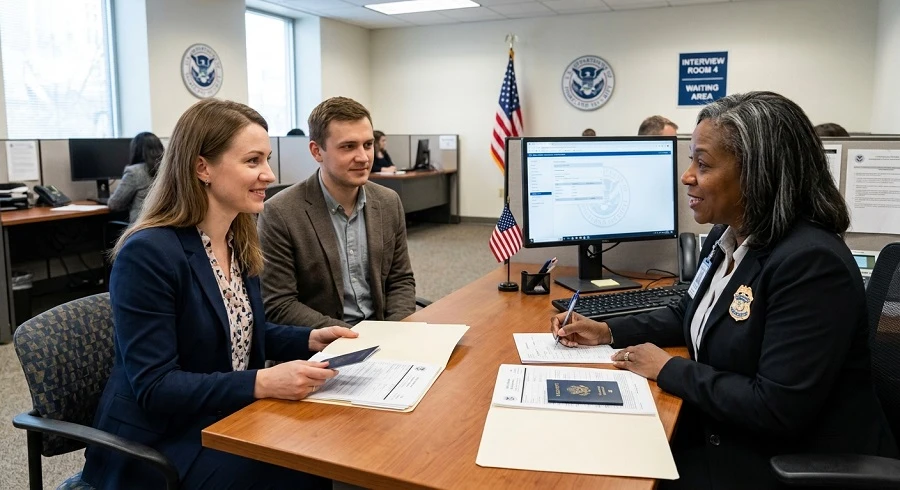
Common Reasons Employment-Based Cases Draw an RFE After the Interview
Most post-interview RFEs in employment-based cases trace back to a handful of recurring issues:
- Missing or outdated Supplement J documentation. If you changed jobs under AC21 portability, USCIS wants clear evidence that the new position is the same or similar to the one in your original labor certification and I-140.
- Questions about whether the job offer is still bona fide. If your employer's circumstances changed (layoffs, restructuring, acquisition), USCIS may ask for updated proof that the position still exists and that you still intend to fill it.
- Incomplete or expired medical exam results. Form I-693 has a limited validity window, and a lapsed exam is an easy, avoidable RFE trigger.
- Discretionary factors under the new policy memo. Following PM-602-0199, some applicants are being asked to submit additional evidence supporting a favorable exercise of discretion, particularly if their record shows any period of unauthorized presence, a status violation, or a lapse in maintaining lawful nonimmigrant status.
- Inconsistent biographic or employment information. Any mismatch between what's in your file and what you said at the interview, such as address history or past employers, can trigger a request to clarify the discrepancy in writing.
Treat any RFE seriously. It isn't a denial, but a weak or incomplete response can turn into one.

FAQs
Do employment-based green card applicants still get interview waivers in 2026?
Some do, but the waiver rate has dropped. USCIS updated its Policy Manual in early 2026 to narrow the circumstances under which interviews may be waived across all adjustment of status categories, including employment-based filings. There's no way to formally request a waiver, as USCIS now decides on a case-by-case basis, and applicants should prepare as though an interview will be scheduled.
How long does an employment-based I-485 interview take?
Most run between 15 and 45 minutes for straightforward cases. Complex cases involving prior immigration violations, criminal history, or inconsistencies in the record can take longer.
What if I changed employers while my I-485 was pending?
If your I-485 was pending for 180 days or more and you moved to a same-or-similar job, you may qualify for AC21 portability. You'll generally need to file Form I-485 Supplement J to document the new position and should bring supporting evidence to your interview.
What happens if I receive an RFE after my interview?
You'll typically have 87 days from the date of the notice to respond with the requested evidence. An RFE isn't a denial, but an incomplete or late response can lead to one.
Does my employer need to attend the interview with me?
No. The employer isn't generally required to appear. If USCIS has questions about the job offer itself, those are usually addressed through a follow-up request for evidence rather than requiring the employer to attend the interview.
How SimVisa Can Help
Preparing for an employment-based green card interview means reviewing your entire filed record, confirming your job facts still match what you submitted, and knowing which questions are routine versus which ones flag a real issue. At SimVisa, our exceptional green card attorneys help employment-based applicants prepare for their I-485 interviews, respond to RFEs and NOIDs, and address AC21 portability questions when a job or employer has changed since filing.
If your case involves a complex immigration history, a change in employment, or concerns about the new discretionary standard for adjustment of status, don't walk into your interview without a clear strategy. Contact us for a case review.