
A foreign company wants to transfer one of its employees to a U.S. office. Maybe it's a manager opening a new branch in an American city, or an engineer who built a proprietary system that no one stateside knows how to run.
The L-1 visa exists for exactly these sorts of situations. It lets multinational companies move key people from foreign offices to the United States without a lottery or an annual cap.
However, meeting the L-1 visa requirements in 2026 takes more than a job title and a plane ticket. USCIS is looking closely at whether both the employee and the petitioning employer actually qualify, and a weak petition can mean months of delays or outright denial.
In this guide, our knowledgeable L-1 visa attorneys cover what you need to know before filing.
What Is the L-1 Visa?
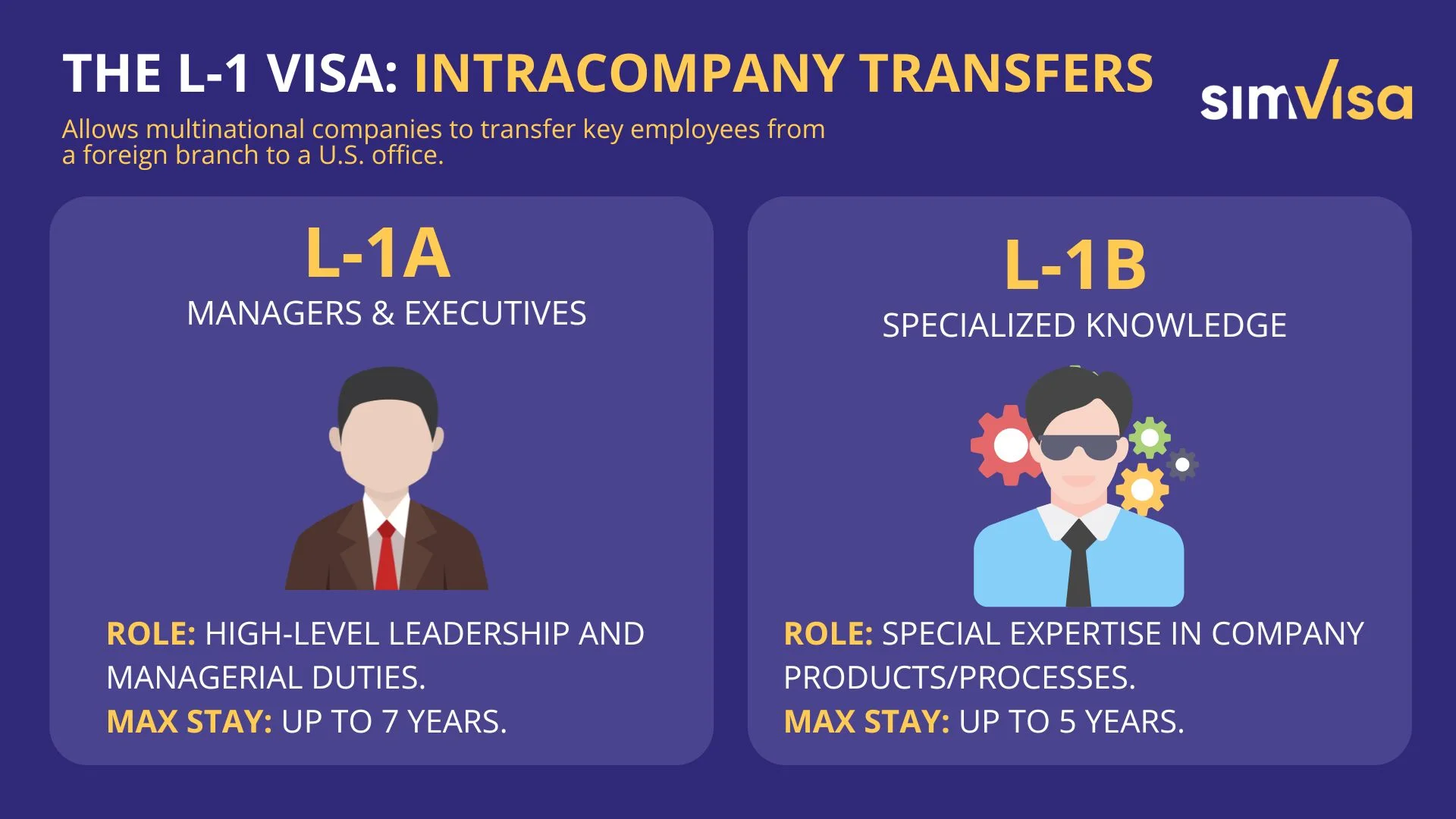
The L-1 visa is a nonimmigrant visa that allows multinational companies to transfer employees from their foreign branches to a related U.S. office. It's designed for intracompany transfers, situations where a qualifying organization with operations in multiple countries needs to move personnel to its American location.
The L-1 classification has two separate subcategories:
- L-1A visa: For employees coming to the U.S. in a managerial or executive capacity; the maximum stay is up to seven years.
- L-1B visa: For specialized knowledge employees who possess proprietary or advanced expertise; the maximum stay is up to five years.
Both categories are dual intent visas, meaning visa holders can pursue permanent residency (a green card) while maintaining their L-1 status. And unlike the H-1B, neither has an annual cap or requires lottery selection — the petitioning employer can file whenever the business need arises.
Employer Eligibility Requirements
Before an employee can qualify for an L-1 visa, both they and their employer must satisfy specific eligibility criteria. On the employer side, USCIS requires the following.
A Qualifying Corporate Relationship
The U.S. entity and the foreign entity must be related as a parent company and subsidiary, a branch office arrangement, or affiliates under common ownership or control. USCIS typically looks for at least 50% common ownership.
To check this box, you'll need an authorized representative to explain ownership and control through foreign company documents, accounts, financial statements, and corporate filings.
Evidence of Doing Business
USCIS also requires proof that both the foreign employer and the U.S. office are conducting real, ongoing commercial activity, not just maintaining a paper presence. Evidence like a business license, tax filings, payroll records, and client contracts can all help establish this.
Physical Premises
Lastly, the U.S. office must have an actual workspace. For a new office petition, updated 2026 USCIS policy guidance clarifies that virtual offices generally aren’t sufficient.
Employee Eligibility Requirements
Employees have their own eligibility requirements to meet under the L-1 structure. Here are the specific criteria.
L-1A Visa (Managers and Executives)
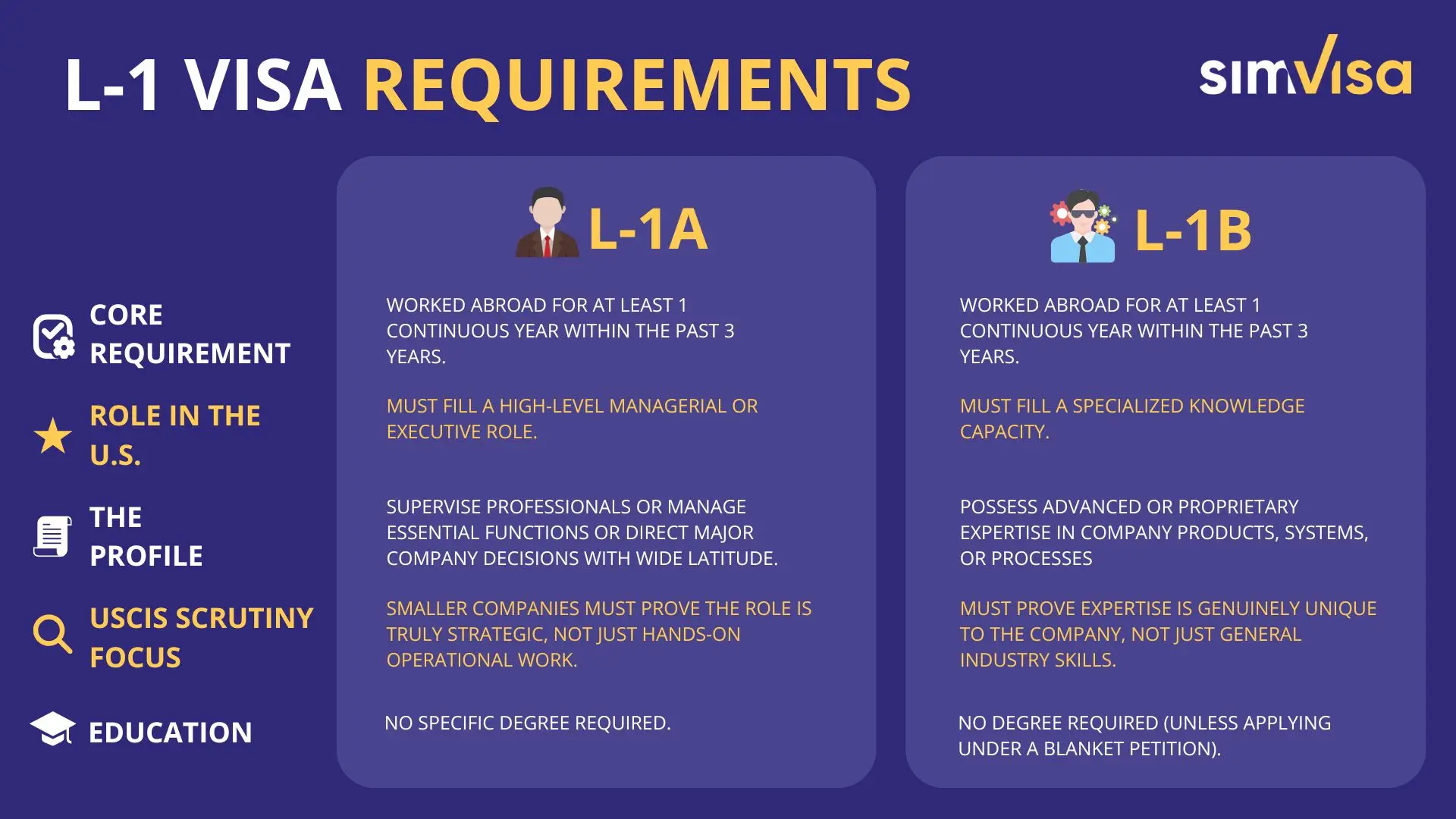
The employee must have worked for the foreign company continuously for at least one year within the three years immediately preceding the transfer. During that time, they must have served in a managerial or executive position, and they must be coming to the U.S. to fill a similar managerial or executive role.
USCIS defines these roles narrowly.
Per the agency’s guidelines, a manager must supervise and control the work of other professional employees, manage an essential function or department, or have authority over hiring and firing decisions. An executive, meanwhile, must direct the management of the organization or a major component and exercise wide latitude in discretionary decision-making.
In smaller companies, USCIS frequently questions whether someone in an executive or managerial position is actually spending most of their time on hands-on operational tasks. The detailed job description, organizational chart, and supporting documentation showing subordinate staff all need to align with the claimed executive capacity.

L-1B Visa (Specialized Knowledge Workers)
The same rule regarding one-year of qualifying employment abroad applies to the L-1B visa as well. The employee must possess specialized knowledge of the company's products, services, processes, or techniques, and must be coming to the U.S. to work in a specialized knowledge capacity.
The challenge here is that "specialized knowledge" is inherently subjective.
USCIS frequently questions whether the employee's expertise is truly unique to the company or just reflects general industry competence. Strong L-1B petitions explain exactly what proprietary systems, internal processes, or company-specific technologies the specialized knowledge professionals work with and why that knowledge can't easily be taught to a domestic hire.
Moreover, unlike the H-1B, the L-1 visa doesn’t require a specific educational credential. Eligibility depends on the role, duties, and qualifying corporate relationship, not academic background. (The sole exception is that specialized knowledge professionals applying under a blanket petition must hold at least a bachelor's degree.)
How the L-1 Visa Application Process Works
The following are the individual steps involved in applying for an L-1 visa.
Step 1: Evidence Preparation
Before filing, the petitioning employer must gather documentation verifying the qualifying corporate relationship (articles of incorporation, ownership records, financial statements, etc.), along with evidence that both entities are doing business, the employee's qualifying employment history with the foreign entity, and a detailed job description for the U.S. role.
For L-1B cases, this also means providing a thorough explanation of why the employee's knowledge qualifies as specialized.
Step 2: Petition Filing
Next, the U.S. employer must file Form I-129 (Petition for a Nonimmigrant Worker) with the L Classification Supplement. The nonimmigrant worker can’t file this themselves; it must come from the employer. As of April 2026, USCIS only accepts the 02/27/26 edition of this form.
Step 3: USCIS Adjudication
USCIS will review the petition and either approve it, deny it, or issue a Request for Evidence (RFE). Under standard processing, this takes approximately two to six months based on data from June 2026.
Premium processing costs $2,965 (as of March 1, 2026) and guarantees that USCIS will take action within 15 business days. It’s important to note that premium processing doesn’t improve your chances of approval — it only speeds up the timeline.
In Quarter 1 of Fiscal Year 2026, L-1A petitions had a 91.6% approval rate across 5,856 completions, and L-1B petitions came in at 91.5% across 3,297 completions. RFE rates were 25.5% for L-1A and 29.3% for L-1B, and the majority of cases that received an RFE were still ultimately approved.

Step 4: Visa Issuance or Change of Status
After the petition is approved, the foreign employee must attend a visa interview at a U.S. embassy or consulate. They'll need a valid passport, the I-797 approval notice, DS-160 confirmation, and supporting documentation. Consular-processing wait times vary but are generally under two months as of June 2026.
If the employee is already in the U.S. on another visa, they may be able to change status without leaving, though this doesn’t produce a visa stamp. If they travel abroad later, they'll need to undergo consular processing before returning.
New Office L-1 Petitions
The new office provision allows a foreign company to send a manager or executive to establish a U.S. subsidiary or branch office even before the American operation is fully up and running.
The initial period for new office approvals is limited to 12 months, after which a request for extension must be submitted. During that time, the transferee is expected to build the business to the point where it genuinely supports a managerial position.
At the end of 12 months, USCIS will look at whether staff was hired, whether the company is generating revenue, and whether the employee is actually performing managerial or executive duties rather than doing everything themselves.
New office petitions require a detailed business plan, evidence of secured premises, and proof of sufficient financial backing. These are among the most intensely scrutinized L-1 filings, and a thin business plan or failure to show combined annual sales and real growth is a common reason for denial.
Blanket Petitions
Large multinational companies can file a blanket petition that pre-qualifies the organization for L-1 transfers.
Once USCIS issues a blanket approval notice, the company can transfer multiple employees without filing individual petitions for each. Instead, specialized knowledge professionals and managers present Form I-129S directly at a U.S. consulate with the blanket approval notice.
To qualify, the company generally needs at least 10 approved L-1 petitions in the past year, $25 million or more in combined annual sales, or at least 1,000 U.S. employees. This streamlined process can save months per transfer for companies that regularly move workers between affiliated foreign offices and U.S. operations.
L-1 Visa Costs in 2026
The petitioning employer is responsible for paying the filing fees, not the employee. Here's the current breakdown (from the 05/29/26 edition):
- I-129 base filing fee: $1,385 (standard employers); $695 (small employers with 25 or fewer employees).
- Fraud Prevention and Detection fee: $500 (initial petitions only).
- Asylum Program fee: $600 (standard); $300 (small employers); $0 (nonprofits).
- Public Law 114-113 surcharge: $4,500 if the employer has 50-plus U.S. employees and more than half are in H-1B or L-1 status.
- Premium processing fee (optional): $2,965.
- Consular fees: Approximately $205 (DS-160) plus $250 (Visa Integrity Fee) plus $24 (I-94).
It’s always a good idea to verify the expected fees against the official USCIS fee schedule before filing.
What Your Family Members Need to Know
The spouse and any unmarried children under 21 of an L-1 visa holder can apply for L-2 dependent status. L-2 spouses can generally obtain work authorization without a separate permit application, provided their I-94 is correctly classified. L-2 children can live in the U.S. and attend school but are not authorized to work.
L-2 applications can be included in the main L-1 petition. However, if family members are already in the U.S. on a different visa, they'll need to file Form I-539 to change their status, and as of June 2026, I-539 processing takes about eight months.

The Path from an L-1 Visa to a Green Card
Because the L-1 is a dual intent visa, holders can pursue lawful permanent resident status while maintaining their nonimmigrant status. Here’s a quick overview of the possible pathways.
L-1A to EB-1C
For those in a managerial or executive role, the EB-1C green card category is one of the most expedient routes to permanent residency. It doesn’t require PERM labor certification, which eliminates one of the longest steps in the employment-authorization process for an immigrant visa.
L-1B to EB-2/EB-3
Specialized knowledge workers can pursue a green card through EB-2 or EB-3, but these routes require PERM labor certification and can involve long wait times.

A Note on PM-602-0199
In May 2026, USCIS issued Policy Memorandum PM-602-0199 directing officers to treat adjustment of status as discretionary, "extraordinary" relief. While this doesn't change L-1 eligibility or the green card categories themselves, it signals closer scrutiny of I-485 applications.
L-1 holders with clean immigration records and maintained status are in a relatively strong position, but the documentation bar for the final step has been raised. Talk to an immigration attorney about how this change may affect your green card timeline.
Common Reasons L-1 Petitions Are Denied
Although many L-1 visa petitions are successful, it’s possible for them to fail for various reasons. Here are a few common causes for denial:
- Vague job descriptions: Petitioners must be clear about what decisions the employee makes, who reports to them, and how much time they spend on managerial tasks.
- Weak organizational charts: If the chart shows one person above and one below, USCIS will likely question whether the role is truly managerial.
- Generic claims: Saying someone has "extensive proprietary knowledge" without concrete examples of what it is and why it's unique to the company can trigger an RFE.
- Outdated forms: Filing an older edition of Form I-129 will result in automatic rejection.
- New office extensions without growth: If the business didn't develop as projected, the extension will likely be denied.

FAQs
Can I apply for an L-1 visa on my own?
No. The U.S. employer must file the L-1 petition on behalf of the nonimmigrant worker. Employees cannot self-petition.
Does the L-1 require a specific degree?
No. Eligibility is based on the employee's role, qualifying employment abroad, and the qualifying relationship between entities, not academic credentials. That said, there is an exception for blanket petition applicants, who must hold at least a bachelor's degree.
Can I change employers on an L-1?
The L-1 visa is tied to the petitioning employer and the qualifying corporate relationship. Switching to an unrelated company requires a new petition with a new employer.
How long can I stay in the U.S. on an L-1 visa?
L-1A holders can stay up to seven years, and L-1B holders can stay up to five years. New office petitions receive an initial period of one year.
Can my spouse work in the U.S.?
L-2 spouses can generally obtain employment authorization. Check the USCIS Policy Manual for current guidance on L-2 work authorization.
What's the difference between standard and premium processing?
Standard processing takes roughly six months in most cases. Premium processing costs $2,965 and guarantees action within 15 business days, though it doesn’t guarantee approval.
Get Help with Your L-1 Visa Petition from SimVisa
The L-1 visa application process involves strict eligibility requirements, detailed documentation, and real stakes if something goes wrong.
Whether your company is looking to transfer employees from foreign offices to a new U.S. location or you're an employee preparing for an intracompany move, the right legal guidance can mean the difference between a quick and efficient approval and months of delays.
The employment-based immigration attorneys at SimVisa have extensive experience with both L-1A and L-1B petitions, from building the evidence package and filing the petition to preparing clients for the visa interview and planning their path to permanent residency. We work with both multinational companies and individuals across the U.S.
Contact us today to discuss your case and get help taking the next step.