
If your company is transferring you to the United States, the L-1 visa category may be the right tool. However, there are two different L-1 visas, L-1A and L-1B, and each has different eligibility standards, time limits, and implications for your long-term plans. Choosing the wrong one can mean denial, a shorter time in the U.S., or a closed door on a future green card.
At SimVisa, we help clients work through this important decision, and the right answer almost never comes down to job title alone. In this guide, our L-1 visa lawyers break down the key differences between the L-1A and L-1B visas, how USCIS evaluates each category, and how to think about the choice with your medium-term and long-term goals in mind.
What Is the L-1 Visa, and Why Are There Two Types?
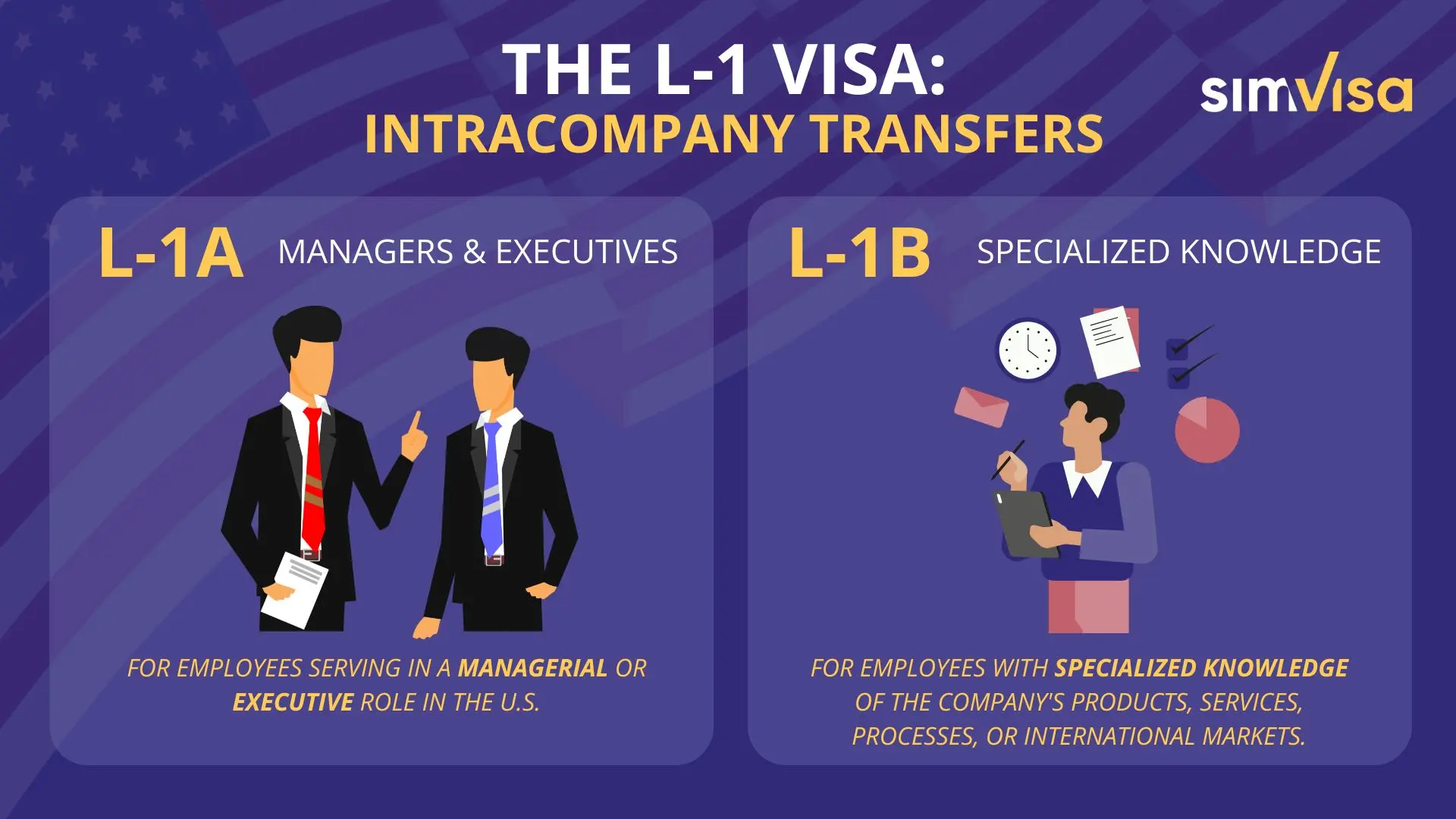
The L-1 is a nonimmigrant visa for intracompany transferees. It allows multinational companies to temporarily move qualified employees from a foreign office to a related U.S. office.
To qualify for an L-1 visa, the employee must have worked for the foreign company for at least one continuous year within the three years before the petition is filed, and the U.S. and foreign entities must have a qualifying corporate relationship (parent, subsidiary, affiliate, branch, etc.).
The L-1 splits into two sub-categories based on what the employee will do in the U.S.:
- L-1A: For employees coming to work in a managerial or executive capacity.
- L-1B: For employees with specialized knowledge of the company's products, services, processes, or international markets.
Both are dual-intent visas, which means the holder can pursue a green card without jeopardizing their nonimmigrant status. Both require the petitioning employer to file Form I-129 with USCIS, and both can be sought as individual petitions or, for larger multinational companies, under a blanket L petition that streamlines the transfer of multiple employees.
That being said, there are also key differences in terms of the employee’s role, the time limits, and what comes after.
L-1A: Executives and Managers
The L-1A visa is for employees coming to the U.S. in a managerial or executive position. USCIS draws those definitions from the Immigration and Nationality Act, and the standard is functional rather than titular. In other words, what the worker actually does on a day-to-day basis matters more than what it says on their business card.
In broad terms, an executive role primarily directs the management of the organization or a major component or function, establishes goals and policies, exercises wide latitude in discretionary decision-making, and receives only general supervision from higher-level executives, the board, or stockholders.
By contrast, a managerial role involves managing the organization or a department, subdivision, function, or component; supervising and controlling the work of other employees, or managing an essential function within the organization. It also entails having authority over personnel decisions if supervising others and exercising discretion over day-to-day operations.
A "functional manager,” someone who manages an essential function of the organization at a senior level rather than personnel, can also qualify. However, the petition must clearly define their function and show that the individual operates at a senior level within the company’s hierarchy.
L-1A status is typically granted in an initial period of up to three years (or one year for a new office petition), with extensions in two-year increments, up to a maximum of seven years.

L-1B: Specialized Knowledge Employees
The L-1B visa is for employees with specialized knowledge, which is defined as either:
- Special knowledge of the petitioning organization's product, service, research, equipment, techniques, management, or other interests, or
- Advanced knowledge of the organization's processes and procedures
USCIS interprets "special knowledge" as knowledge distinct or uncommon compared to what's generally found in the relevant industry, and "advanced knowledge" as that developed well beyond the basic level held by others in the petitioning organization or the industry at large.
Importantly, the knowledge in question doesn't have to be proprietary or held by only one person, but it does have to be demonstrably uncommon.
Here are a few more facts worth knowing about the L-1B category:
- The employee doesn’t need to be a manager, executive, or supervisor, or hold any particular rank. What matters is the knowledge they hold.
- Higher compensation can support an L-1B case, but it isn't required. For example, early-stage companies may not yet pay the beneficiary more than their peers.
- If the employee will work primarily at a third-party site, the petitioner must show that they won't be controlled, supervised, or hired out by the unaffiliated employer.
L-1B status is typically granted in an initial period of up to three years (one year for a new office petition), with extensions possible in two-year increments, up to a maximum of five years.
L-1A vs. L-1B: The Key Differences at a Glance
The two-year difference in maximum stay sounds modest on paper, but in practice, it can mean the difference between completing the green card process inside the U.S. and being forced to leave.
The “Manager” Problem: Why Job Title Doesn't Always Decide the Category
The single most common point of confusion we see regarding L-1 visas is when a client's title says "manager," but the work they do is mostly technical, or vice versa. USCIS doesn't decide the category based on job title alone. The agency looks at what the employee actually does and how much of their time is apportioned to each type of duty.
Consider this breakdown from SimVisa’s co-founder, SohYoon Atac:
"When a client's title says 'manager,' we have to look at what the person literally does. We often give percentages of time the person spends on each task or duty, as crazy as that sounds. It can't just be about what the majority of the work requires. If a role requires technical knowledge but the person isn't primarily doing that work — they're managing others who are — that's more of a manager. Even if you manage some people, if you're mostly doing the work yourself, that's more technical, and we might want to go with an L-1B."
To clarify their role, we typically ask clients to walk us through a typical week. How much time do they spend devising strategy, allocating resources, supervising people, and exercising independent judgment versus actually executing the technical work?
A Senior Engineering Manager who spends 70% of the week coding and reviewing pull requests for two direct reports is, for USCIS’s purposes, much closer to a specialized knowledge worker than a manager. Similarly, a Lead Engineer who spends most of their time directing a team, setting roadmaps, and making hiring decisions may be better suited for an L-1A.
Complications of the L-1B Visa
The specialized knowledge standard for the L-1B is where our attorneys see the most Requests for Evidence (RFEs). USCIS officers are looking for indications that the knowledge is genuinely distinct or uncommon, not just that the employee is good at their job.
The cases that present the most friction tend to involve software-development roles, where it can be hard to draw a line between specialized knowledge and what every senior engineer in the industry knows. As SohYoon explains:
"I think cases with software engineers are a little tough sometimes, because so many people with such different educational and training backgrounds can be software engineers. When the specialized knowledge is just generally software, that can be problematic. We've had great success with fiber laser engineers or people who do more physical, concrete technical work."
The takeaway isn't that software engineers can't get L-1B visas — they can, and many do. It's that the petition needs to clearly explain what specifically the engineer knows about the company's proprietary systems, methodologies, or products that an equivalently credentialed U.S. hire couldn't easily replicate.
Internal training records, authorship of company documentation, proprietary tooling, and detailed comparisons to general industry practice all carry weight. A generic job description and a years-of-experience figure usually don't.
For roles based on highly specific technical or physical expertise (think niche engineering disciplines, specialized manufacturing processes, and proprietary scientific methodologies), specialized knowledge tends to be much easier to demonstrate, as the knowledge itself is more unique on its face.
What the L-1 Category Means for Your Immigration Goals

The main reason the L-1A vs. L-1B decision is so consequential has nothing to do with the visa itself. It's all about what comes next.
The L-1A flows directly into the EB-1C green card category for multinational managers and executives. The EB-1C is a first-preference employment-based immigrant category that doesn’t require labor certification, meaning no labor market test, no recruiting U.S. workers, and a much shorter process.
For applicants born in most countries, an EB-1 priority date is current, allowing concurrent filing of the I-140 immigrant petition and I-485 adjustment-of-status document.
The L-1B doesn’t transition into the EB-1C. Instead, L-1B holders generally pursue a green card through EB-2 or EB-3, both of which require PERM labor certification, a process that can add a year or more to the overall timeline.
For some applicants, EB-2 NIW (national interest waiver) or EB-1A (extraordinary ability) may be alternatives, but those are distinct categories with their own demanding criteria.
This is why we always look at the full trajectory of the case, not just the initial filing. Sometimes, the strongest immediate choice is an L-1B, but the client's actual goal is permanent residence as a multinational manager or executive. In such situations, the setup of the L-1B is extremely important.
SohYoon sheds some light on how we approach this particular scenario:
"We've had situations where, for whatever reason, a person doesn't really qualify for L-1A; maybe the U.S. entity just isn't strong enough to support an executive or manager under USCIS standards. It makes sense for them to come as an L-1B, but they genuinely have specialized knowledge, and they're also working in a managerial context. So we bring them as an L-1B, but we'd include in the petition documentation of the managerial nature and at least one year of experience at the company abroad. The L-1B is only good for up to five years, and then the person has to leave for a while. But should they want to transition to an EB-1 green card, which is amazing because there's no labor certification, we don't want to cut out that possibility. The L-1B doesn’t flow to EB-1C automatically, but it's possible so long as we preserve that option at the L-1B stage. Then, we can leave the door to the EB-1 green card open instead of having to go through labor certification."
Even when initially filing for an L-1B, you can and should document the managerial nature of at least one of the three qualifying years of foreign employment. If circumstances later support an EB-1C petition, that foundation will already be in place. While skipping that step doesn't make obtaining an EB-1C impossible, it does make it much harder.
The New Office L-1
If the U.S. entity has been doing business for less than one year, the petition is treated as a "new office" L-1A, and the rules tighten.
For a new office L-1A, the petitioner must show that sufficient physical premises have been secured, that the beneficiary has been employed in a qualifying capacity for one continuous year in the prior three years, and that the proposed enterprise will support an executive or managerial position within one year of approval.
New office approvals are granted for only one year initially, and extensions require concrete evidence that the office is actually operating (payroll, lease, revenue, organizational growth, etc.), not just incorporated.
The new office L-1A is one of the L-1 filings that’s most prone to Requests for Evidence, and it's also one of the most consequential. A weak business plan, a thin organizational chart, or premises that look more like a virtual address than a working office are all common reasons for denial.
Who Files, What's Required, and How Long It Takes

To secure an L-1 visa, the U.S. employer (the petitioning organization) must file Form I-129, Petition for a Nonimmigrant Worker, along with the supporting documentation, which should include:
- Evidence of the qualifying corporate relationship between the U.S. and foreign entities;
- Evidence of the beneficiary's one continuous year of qualifying employment abroad within the prior three years;
- A detailed support letter from the U.S. employer describing the proposed role and duties;
- Documentation showing that the position is genuinely managerial or executive (for L-1A);
- Documentation establishing and outlining the specialized knowledge (for L-1B);
- Lease, business plan, financial projections, and proof of physical premises (for new office L-1A).
Premium processing is available for L-1 petitions. For an additional fee, USCIS will guarantee a decision within 15 business days. Without premium processing, adjudication times vary based on service center and case complexity.

FAQs
What's the main difference between an L-1A and an L-1B visa?
The L-1A is for employees coming to the U.S. in a managerial or executive capacity, and it allows a maximum stay of seven years. The L-1B is for employees with specialized knowledge of the company's products, services, processes, or international markets, and it allows a maximum stay of five years.
Additionally, the L-1A can lead directly to an EB-1C green card for multinational managers and executives, while the L-1B can’t.
Can my job title alone determine whether I qualify for L-1A or L-1B?
No. USCIS evaluates the duties, time allocation, and authority associated with the role, not just the title. A team manager who spends most of their time doing technical work may be a better L-1B candidate, while an engineer who primarily directs others and exercises managerial discretion may qualify for an L-1A.
How long can I stay in the U.S. on an L-1A or L-1B visa?
L-1A status is granted for an initial period of up to three years (one year for new office petitions), with extensions in two-year increments, up to a maximum of seven years. L-1B status follows the same initial time frame but is capped at a maximum of five years.
Can I switch from an L-1B to an L-1A during my stay?
It's possible to change classification from L-1B to L-1A, but the petitioner must show that the beneficiary now meets the L-1A managerial or executive standard. USCIS will look beyond the title change to the substance of the new role. In general, a switch to L-1A must be requested and approved at least six months before the maximum L-1A stay period has been reached.
Can my spouse work on an L-2 visa?
Yes. L-2 spouses are employment-authorized incident to status and may work in the U.S. once they receive their L-2S admission stamp or have an unexpired EAD. Children under 21 receive L-2 dependent status but aren’t authorized to work.
How SimVisa Helps with L-1 Petitions
The L-1A vs. L-1B decision isn't as simple as checking a few boxes. It's a pivotal choice that will affect the next several years of a professional's life (and often their family's). We start every L-1 consultation by asking two questions: What does the actual day-to-day work look like, and where do you want to be five years from now?
The experienced immigration lawyers at SimVisa work with multinational companies and transferring employees to structure L-1 petitions that match the demands of the role and preserve future options, including a clear path to an EB-1C green card where that's the long-term goal.
Whether you’re a company leader opening a new U.S. office, a manager transferring into an existing operation, or a specialized knowledge employee whose role straddles the line between technical and managerial duties, we can help you pick the right category and build a petition that holds up to USCIS scrutiny. Contact us today for a case review.